The short answer
For a networking event, a small acoustic ensemble — a jazz duo or acoustic duo from €900 excl. VAT — is almost always the right choice. The volume needs to stay low enough for a normal-toned conversation, and that's exactly where a DJ or band with PA most often goes wrong.
The reverse goal of other events
At a gala dinner or staff party, the music is there to stand out — it carries the evening. At a networking event, the opposite is true: the music has succeeded when nobody consciously notices it. The goal of the evening is for strangers to start a conversation, exchange business cards, fill a silence between two people who don't know each other without anyone having to shout. Music that's too emphatic for that works directly against the goal of the evening.
Why this goes wrong more often than you'd think
The most common mistake at networking events isn't the absence of music, but the wrong intensity: a DJ turning it up as the room gets busier, or a band playing at full strength in a space that actually calls for restraint. The result is predictable — guests start talking louder to make themselves heard, the music in turn goes even louder to be heard above the conversations, and within half an hour everyone is shouting. That vicious little circle is exactly the scenario that makes a networking event unworkable.
What actually works
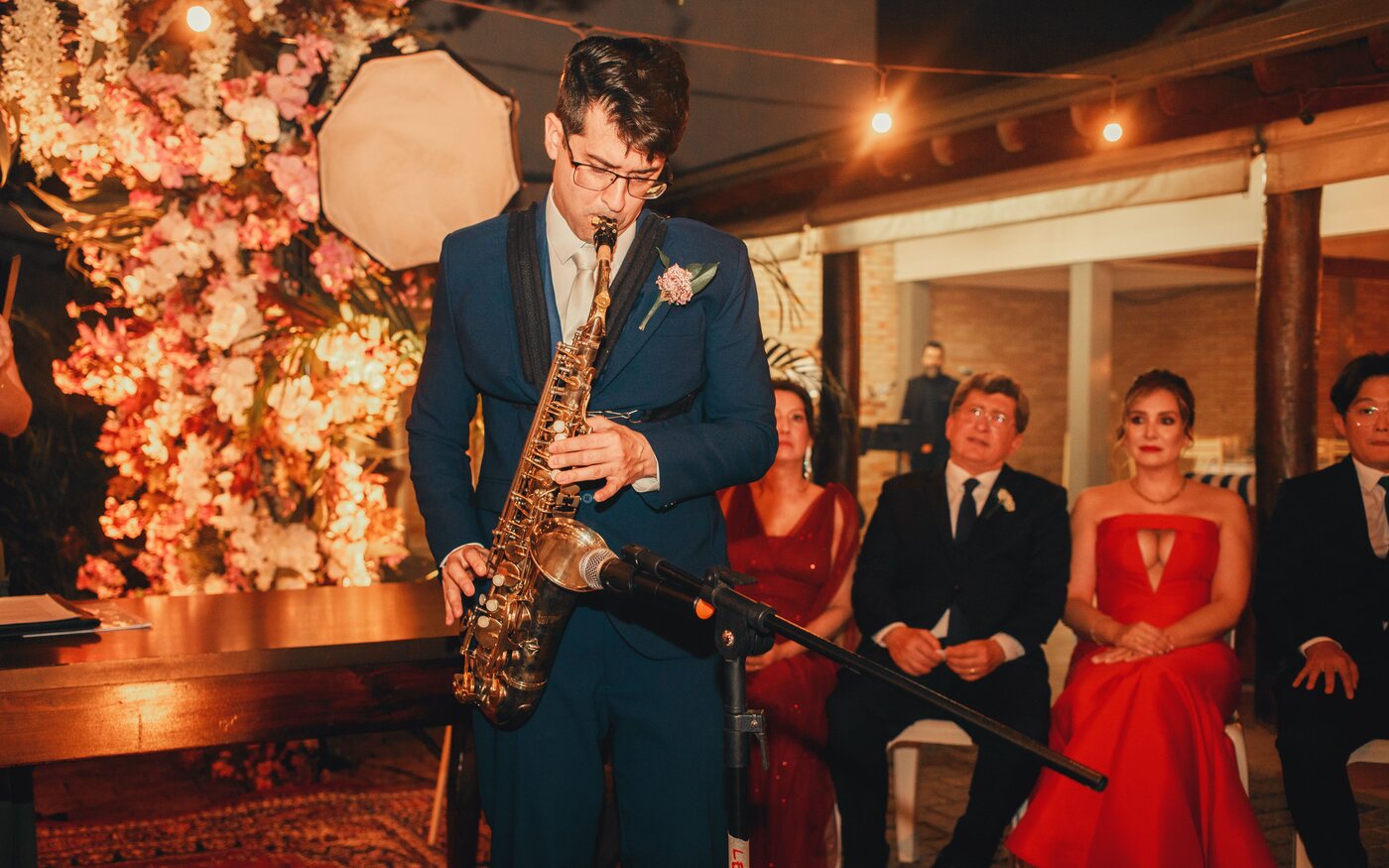
Fully acoustic line-ups are the safest choice here, precisely because they physically can't "scale up" the way a PA can. Along Comes Mary as a jazz duo (from €900 excl. VAT) is our most-booked format for networking events: recognisable, internationally understandable repertoire, never intrusive. For a slightly larger space or a longer evening, Belpop Acoustic (from €950) works just as well, with a warmer, Belgian-oriented register. Both ensembles need no PA — so there's physically no risk of the volume spiralling out of control.
Is the space bigger or does it echo strongly? The instinctive reaction is often "more volume," but the better solution is almost always less music: a single acoustic guitarist or pianist in a corner of the room, rather than a fuller ensemble with amplification.
Timing: shorter than you'd think
A networking event rarely lasts longer than an hour and a half to two hours, and the music doesn't need to play the whole time. Many clients choose to have the musicians start as soon as the first guests arrive and stop once the room fills up well — the moment when a hundred conversations at once determine their own sound level anyway and music becomes redundant.
Networking event versus reception: a small but real difference
The two look alike but differ in purpose: a reception celebrates something (an anniversary, an opening), a networking event facilitates something (business contact). At a reception, the music may be a little more present — it underscores the festivity. At a networking event, it stays functional: social lubricant, not the lead role. For the more festive variant, read music for a reception or anniversary.
 Practical advice from Reinout
Always ask yourself the same question at a networking event: would I, two tables over, still be able to just talk? If the answer is no, the volume is wrong — no matter how good the ensemble is. That's the only test that matters.
In practice: budget and organisation
Budget €900 to €1,400 excl. 6% VAT for a networking event of an hour and a half to two hours, depending on ensemble choice and venue. Technique is minimal to non-existent — acoustic ensembles need no power, which also makes them practically the simplest choice for venues without a stage or power supply. The full overview of corporate event scenarios, including networking events, is in the complete guide for corporate events.